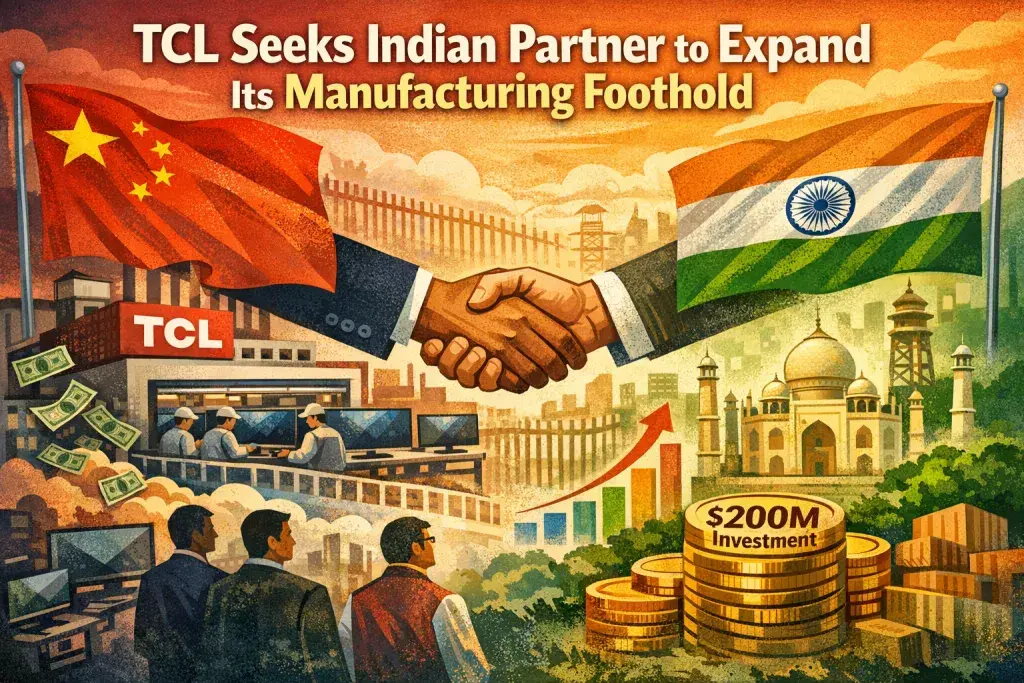
TCL Technology Group Corp., one of China's largest consumer electronics manufacturers, is exploring a sale of a minority stake in its Indian television manufacturing unit to local investors, with a target of raising at least $200 million. The move, confirmed by people familiar with the matter who asked not to be named, reflects a broader recalibration by Chinese electronics firms seeking to deepen their presence in India while managing the political and commercial sensitivities that come with it.
Why Local Ownership Has Become a Strategic Imperative
India's consumer electronics market is among the fastest-growing in the world, driven by a large and youthful population, rising disposable incomes, and rapid urbanisation. For foreign manufacturers, the country represents both an enormous opportunity and a complex operating environment. Regulatory pressure, import duties on finished goods, and a strong government push for domestic manufacturing under its production-linked incentive schemes have made local partnerships less a matter of preference and more a condition for sustainable growth.
Chinese companies face an additional layer of scrutiny. Since a series of border tensions between India and China beginning in 2020, Indian authorities have tightened oversight of Chinese investment, slowed regulatory approvals for Chinese-linked businesses, and imposed restrictions on certain Chinese apps and products. In this climate, a company that can present itself as locally rooted — with Indian shareholders, Indian management stakes, and supply chains tied to domestic production — operates with considerably less friction than one perceived as a purely foreign outpost.
Haier's Deal Offers a Precedent and a Template
TCL's exploration closely follows a deal struck by Haier Smart Home, another major Chinese household electronics brand. Late last year, Haier agreed to sell a 49% stake in its Indian operations to Bharti Enterprises and private equity firm Warburg Pincus. Haier described the arrangement as central to a "Made in India, for India" strategy — a framing that is as much about regulatory positioning as it is about genuine localisation.
The Haier transaction set a visible precedent: that a substantial minority stake sold to credible Indian partners can serve as both a commercial and reputational reset. For Bharti, a conglomerate with interests spanning telecommunications and retail, the deal added consumer electronics to its portfolio. For Warburg Pincus, it represented a bet on India's durable goods market. For Haier, it bought goodwill with Indian regulators and consumers alike. TCL appears to be reading from the same logic.
What a Deal Would Mean for TCL's India Ambitions
TCL is already a significant presence in India's television market, competing with Samsung, LG, Sony, and domestic brands such as Xiaomi's television line and Vu. The company manufactures locally and has built recognition particularly in the mid-range segment. A capital infusion of $200 million or more could fund expanded production capacity, a broader product range, or deeper distribution into smaller cities and towns — markets that are growing faster than metropolitan centres.
Beyond capital, a local partner would bring institutional knowledge, distribution networks, and political relationships that a foreign parent cannot easily replicate. The identity of any prospective Indian buyer has not been disclosed, and TCL's representative stated that the company has no information requiring public disclosure and does not comment on market rumours. Talks are described as preliminary, and no deal is guaranteed.
A Pattern With Wider Implications
The moves by TCL and Haier are not isolated decisions. They reflect a structural shift in how Chinese manufacturers are approaching India — moving from export-led or wholly foreign-owned models toward joint ownership structures that embed them more firmly in the local economy. This mirrors patterns seen decades earlier when Western multinationals found that joint ventures were the price of meaningful market access in China itself.
For India, the influx of this kind of structured foreign investment carries its own questions. Local partners gain capital, technology transfer, and manufacturing know-how. But regulators and policymakers will need to weigh whether minority Chinese stakes in consumer electronics — a sector touching millions of households — require additional oversight frameworks. The electronics industry sits at an intersection of commerce, data infrastructure, and national supply chain policy. As more deals of this kind emerge, that intersection will demand clearer public rules rather than case-by-case negotiation.